
Find the exact water filter your fridge takes
Type your fridge brand or model below, or pick a brand from the list.
Start typing a brand name, model name or filter reference code.
How to read a fridge water filter reference code
Every fridge water filter sold in the UK carries a manufacturer part number printed on the cartridge itself, usually a mix of letters and digits such as DA29-00020B, ADQ73613401 or SBS002. That code is not a random product name. It describes the exact housing shape, thread or twist lock pattern, and internal filtration standard the cartridge was built to. Two cartridges can look almost identical in a search results page and still fail to seal properly, or simply not fit, if the reference does not match, because the difference between two systems from the same brand is often the housing diameter or the direction a locking tab turns.
Manufacturers reuse the same reference across many models that share the same internal housing, which is why one code, such as Samsung's DA29-00020B, can cover several years of French door and side by side fridges rather than a single model. The trade off is that when a manufacturer changes the housing, usually every few years, the old reference is retired for new production and a different one takes over, sometimes alongside the old one if both housings are still sold. This is why two fridges from the same brand, bought a few years apart, can need completely different filters even though the appliance looks similar from the outside.
| Where the code usually sits | What to look for |
|---|---|
| Printed on the old cartridge itself | Letters plus digits, for example DA29-00020B, ADQ73613401, SBS002 |
| Printed on a sticker inside the fridge compartment | Often near the filter door or on the side wall, naming the filter type or the fridge's own model number |
| In the fridge's user manual | Listed under consumables, spare parts or water filter replacement |
Where to find it on the fridge
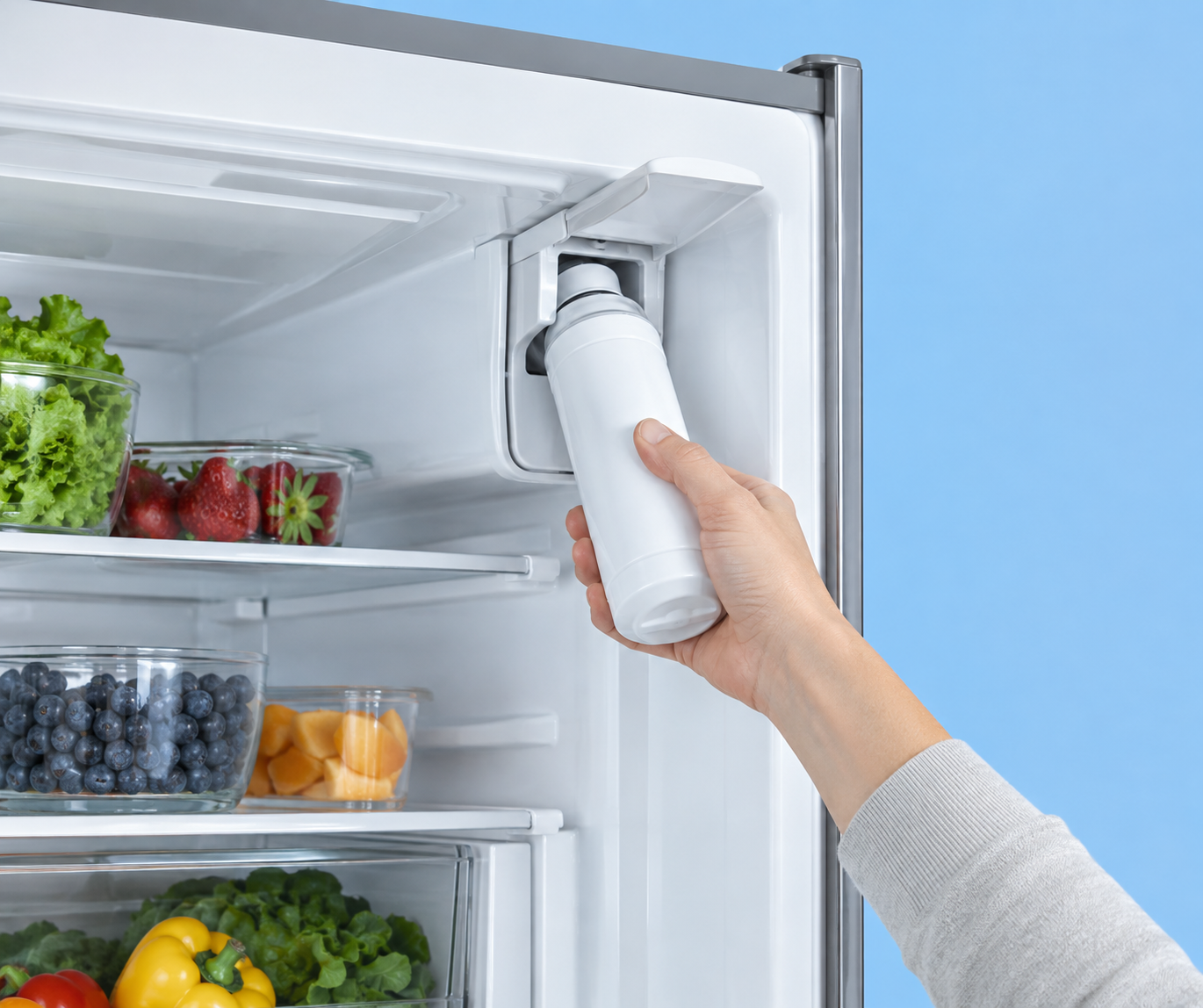
- Open the filter door, usually inside the fresh food compartment or at the base grille, and read the reference printed on the old cartridge before you throw it away.
- Check the side wall or ceiling of the fresh food compartment for a rating plate carrying the fridge's own model number, then search that model number using the tool above.
- If there is no visible filter door anywhere inside the fridge, check behind or underneath the appliance for an external cartridge fitted on the water supply pipe.
How often to replace it
Most manufacturers recommend changing a fridge water filter every six months, regardless of brand, because the carbon block inside loses its ability to filter effectively well before it looks visibly dirty. Many fridges track water usage and light up a filter indicator when a change is due, which is a more reliable signal than the calendar if your household uses more or less water than average.
Step by step check before you order
Use the old cartridge as the main evidence, not the fridge brand name alone. Turn the ice maker off if the fridge has a switch, then close the small water isolation valve feeding the fridge if it is easy to reach. Put a towel under the filter area, because 50 to 200 ml of water can drain from the housing when the cartridge is removed.
Remove the cartridge and read every printed line under good light. The useful code is usually 6 to 12 characters long and often contains both letters and numbers. Ignore dates, batch codes, certification text and long barcodes unless they are the only readable markings left. If the label is wet or faded, dry it and take a phone photo with flash, then zoom in rather than guessing a missing character.
Measure the cartridge only as a secondary check. Overall length, body diameter and the shape of the head help confirm a match, but they do not replace the printed reference. A common internal cartridge is roughly 20 to 30 cm long and 5 to 8 cm wide, while many external inline cartridges are longer and slimmer, often fitted horizontally or vertically on 6.35 mm plastic water tube.
If the fridge is still fitted in a kitchen cabinet, leave space to work before ordering. Some internal filters need about 90 degrees of rotation to unlock. Base grille filters often need 10 to 15 cm of clear space in front of the appliance so the cartridge can slide out straight without bending the housing.
Equipment, measurements and checks to record
You do not normally need specialist tools to identify a fridge filter, but a few simple items prevent errors. Record the details before disposing of the old cartridge. If the filter is external, also record the tube size and fitting type before cutting or disconnecting anything.
- Phone camera, for close photos of the printed code, the head shape and the installed position.
- Tape measure or ruler, to record the full cartridge length and the widest body diameter in millimetres.
- Towel and shallow tray, to catch residual water from the housing or tube.
- Marker pen and masking tape, to label the water tube direction on an external filter before removal.
- Small torch, to read rating plates inside the fresh food compartment or near the lower hinge area.
For an external inline filter, check whether the tube enters with push fit connectors or threaded fittings. UK fridge water lines are commonly 6.35 mm outside diameter plastic tube, also called quarter inch tube. Do not assume this if the installation has been altered, because older or adapted pipework may use reducers.
Figures to compare before choosing a match
| Check point | Useful figure | What it tells you |
|---|---|---|
| Internal cartridge length | About 20 to 30 cm | Confirms the physical family, but not the exact lock pattern. |
| Internal cartridge diameter | About 5 to 8 cm | Helps separate slim and wide housings that can look similar in photos. |
| External inline tube size | Often 6.35 mm outside diameter | Helps identify the connection type for filters fitted on the supply pipe. |
| Water to discard after fitting | Usually 3 to 5 litres | Flushes loose carbon fines and trapped air after installation. |
| Time to check for leaks | 2 minutes immediately, then again after 24 hours | Catches slow weeps around fittings or the filter head. |
After fitting any replacement, run water through the dispenser until it flows clear and steady. The first litres can contain harmless black carbon dust and air bubbles. If the fridge has an ice maker, discard the first full bin of ice after a filter change, especially if the water supply was off for more than a few minutes.
Common mistakes, recovery and special cases
If the cartridge will not turn fully into place, stop before forcing it. Remove it, compare the locking tabs with the old one, and check for a protective cap or transport plug still fitted to the new cartridge. A forced cartridge can damage the plastic head, which is usually more difficult to replace than the filter itself.
If water does not flow after replacement, check the isolation valve first, then remove and refit the cartridge. Some housings need a firm push inward before the twist starts. If the dispenser sputters, run water for 30 to 60 seconds at a time with short pauses until the air clears.
If there is a leak at an external inline filter, isolate the water supply and depressurise the line at the dispenser. Push fit connectors usually need the tube cut square, with no scratches in the last 15 mm. A tube cut at an angle may seal for a few minutes and then drip later.
Special cases need extra care. A second hand fridge may contain a non original external filter added by an installer, so the appliance model alone may not identify it. A fridge connected to a reverse osmosis system may have lower feed pressure, which can slow dispensing after a change. A fridge with no dispenser can still have a filter for the ice maker only. If the old cartridge is missing, use the appliance rating plate and clear photos of the housing, then compare your findings with the help topics in the FAQ.